CRM Comparison & Ratings
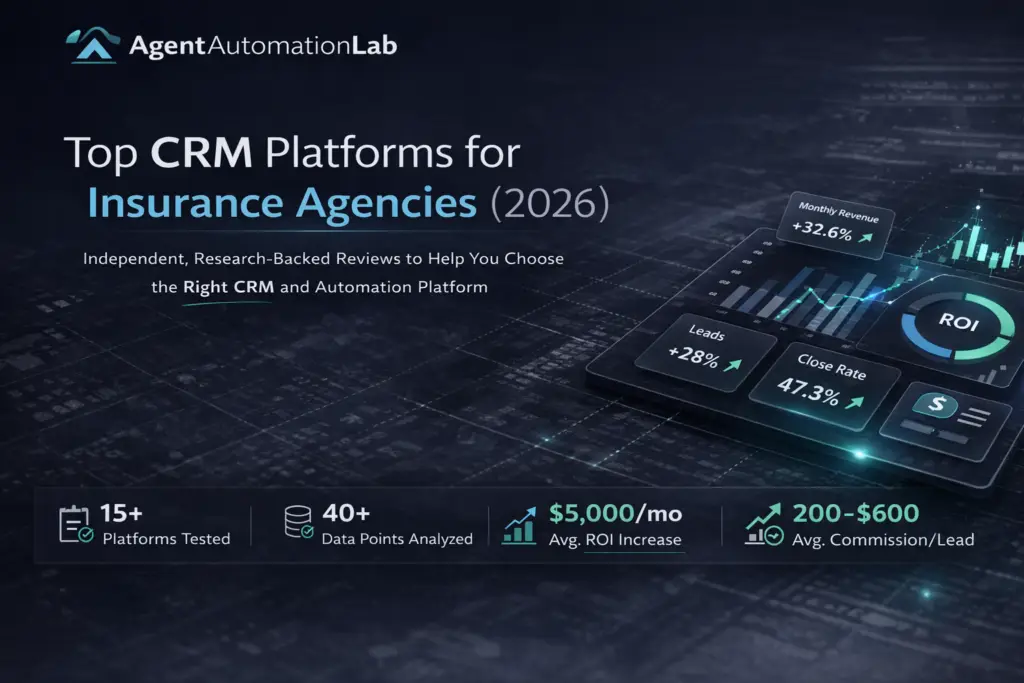
Here are our top-rated CRM platforms for insurance agencies based on automation strength, ease of use. and overall ROI potential. Last Updated 2/25/2026
Platform
Best For
Starting Price
Automation Depth
Ease of Use
ROI Score
Setup Time

Life & Medicare Agents
$149/mo
9.6/10
30 Min

High-Volume / Growth-Focused Agencies
$297/mo
9.0/10
45 Min
P&C Agencies
Custom
8.8/10
40 Min

Marketing-Driven Agencies
$45/mo
8.4/10
25 Min

Budget / Solo Agents
$37/mo
7.9/10
35 Min
Enterprise P&C Agencies
Custom
8.7/10
60+ Min

Core features insurance Agencies Need
AgencyBloc CRM Review for Insurance Agencies
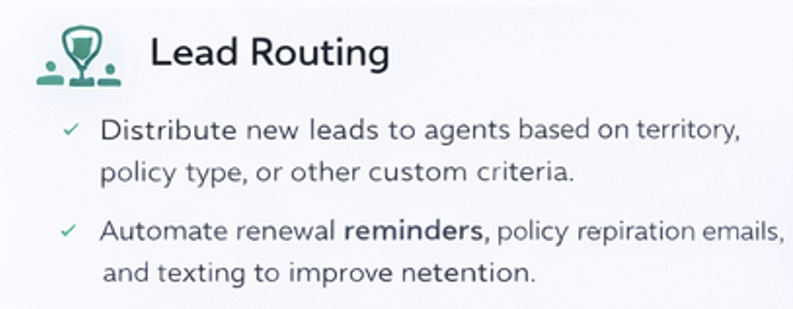
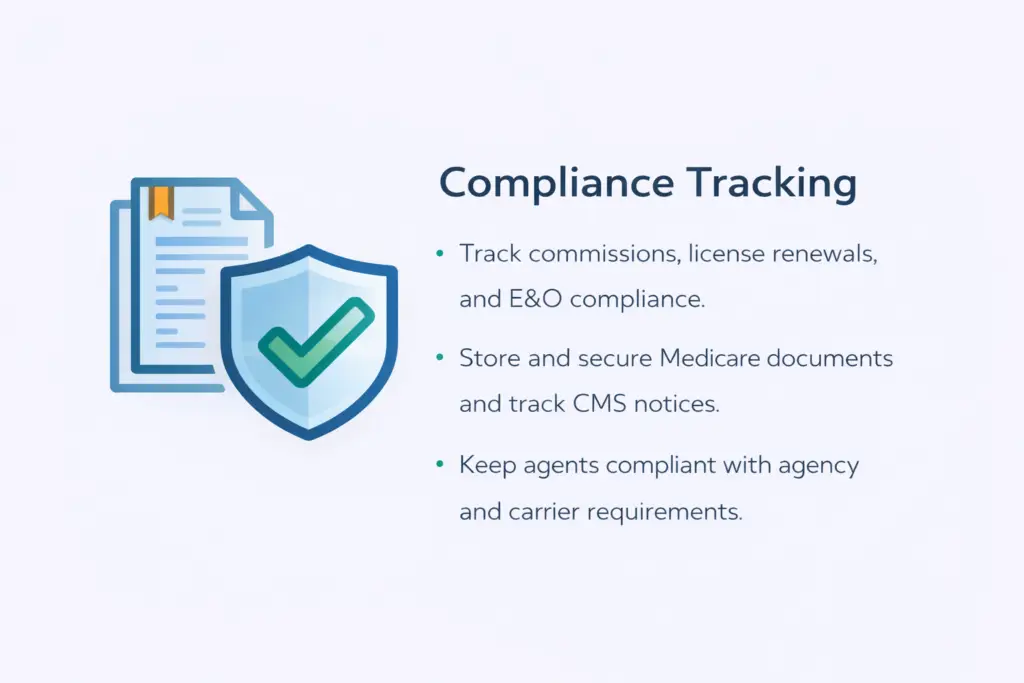
AgencyBloc is a CRM platform designed specifically for insurance agencies, with a strong emphasis on life, health, and benefits producers. Unlike broader CRM systems that require customization to fit insurance workflows, AgencyBloc is structured around policy management, commission tracking, and carrier relationships from the outset. For agencies that prioritize industry-specific alignment over deep marketing automation, this positioning can be compelling.
One of AgencyBloc’s primary strengths is its focus on insurance data organization. The platform centralizes client records, policy details, renewal tracking, and commission reporting within a single system tailored to producer workflows. Agencies managing large books of business often benefit from having policy-level visibility integrated directly into their CRM environment rather than relying on spreadsheets or external commission tracking tools.
The system also includes task management and follow-up reminders designed to support renewal cycles and client retention. For agencies focused on maintaining existing policies and monitoring commission flows, this structured approach can provide operational clarity. The reporting features are oriented around production and performance tracking, which may appeal to agency owners seeking visibility into producer output.
However, AgencyBloc is not built as a marketing automation platform. Compared to systems like GoHighLevel or HubSpot, it offers less depth in terms of advanced workflow automation, funnel creation, and multi-channel nurture sequencing. Agencies that rely heavily on digital lead generation and automated prospect follow-up may find its automation capabilities more limited. In those cases, some teams supplement AgencyBloc with external marketing tools.
Pricing is generally structured around user tiers, and costs scale with additional functionality and team size. Agencies should evaluate total long-term costs relative to both commission tracking needs and automation requirements. The value proposition lies in its insurance-specific design rather than broad marketing flexibility.
Overall, AgencyBloc is best suited for insurance agencies that prioritize policy management, commission visibility, and structured renewal tracking over advanced marketing automation. Agencies focused on life, health, and benefits production—particularly those managing substantial policy volume—may find it aligned with their operational needs. For teams seeking deeper automation control or integrated marketing funnels, alternative platforms may offer greater flexibility.
GoHighLevel CRM Review for Insurance Agencies
GoHighLevel is positioned as an all-in-one CRM and marketing automation platform designed for service-based businesses and agencies. For insurance agencies evaluating automation depth and lead management capabilities, the platform stands out primarily for its workflow builder and integrated communication tools rather than traditional policy-centric features.
One of GoHighLevel’s defining characteristics is its automation framework. The platform allows agencies to build trigger-based workflows that can respond to lead behavior, time delays, appointment status changes, and pipeline movement. For insurance agencies generating inbound leads through paid advertising or online funnels, this type of automation can help reduce manual follow-up and create more structured prospect nurturing. Agencies that prioritize operational efficiency may find this level of workflow control appealing.
GoHighLevel also consolidates multiple communication channels within one system. SMS messaging, email campaigns, call tracking, appointment scheduling, and landing page creation are integrated into the broader CRM environment. This consolidation may benefit agencies seeking to reduce reliance on separate tools for marketing and communication. Instead of layering a CRM on top of external automation platforms, the system attempts to centralize those functions.
However, GoHighLevel is not built specifically for insurance policy management. Agencies requiring detailed commission tracking, carrier-specific reporting, or policy-level data organization may need additional systems to supplement their operations. The platform’s strength lies in automation and marketing infrastructure rather than industry-specific policy workflows. Agencies primarily focused on renewals and commission management may find more alignment with insurance-native CRMs.
In terms of pricing, GoHighLevel operates on a tiered subscription model that scales with additional features and agency capabilities. While not positioned as a low-cost CRM, its value proposition is often framed around replacing multiple marketing and automation tools with one integrated platform. Agencies should evaluate long-term operational needs when comparing costs against both marketing-focused and insurance-specific alternatives.
Overall, GoHighLevel may be best suited for insurance agencies prioritizing automation control, structured lead follow-up, and integrated marketing systems. Agencies running digital lead generation campaigns or seeking to automate multi-step nurture sequences may find the platform’s architecture aligned with those objectives. Teams primarily concerned with policy administration and commission visibility may require a different core system or a hybrid technology stack.
EZLynx CRM Review for Insurance Agencies
EZLynx is an insurance-focused management system and CRM platform designed primarily for independent property and casualty agencies. Unlike general-purpose CRMs that require customization to support insurance workflows, EZLynx is structured around quoting, policy management, and carrier integration. For agencies seeking a system closely aligned with insurance operations, this specialization can be a defining factor.
One of EZLynx’s primary strengths is its integration with comparative rating tools and carrier systems. Agencies that rely on multi-carrier quoting may benefit from having rating functionality and client data connected within a unified environment. This can streamline parts of the sales process and reduce duplicate data entry when moving from quote to policy management. For independent agencies focused on P&C production, this operational alignment may offer efficiency advantages.
The platform also includes CRM functionality intended to support pipeline visibility, task tracking, and customer communication. While not positioned as a marketing automation platform in the same way as systems like GoHighLevel, EZLynx does provide structured tools for managing client relationships and follow-up within an insurance-specific framework. Agencies that prioritize policy lifecycle management over advanced automation workflows may find this approach more aligned with their needs.
However, EZLynx is not primarily built as a digital marketing automation system. Agencies running complex lead generation funnels or seeking trigger-based multi-channel nurture sequences may find its automation capabilities more limited compared to marketing-centric platforms. Its strength lies in insurance operations rather than broad marketing infrastructure.
Pricing for EZLynx typically reflects its positioning as a comprehensive agency management solution, with costs varying based on agency size, modules selected, and carrier integrations. Agencies evaluating long-term value should consider how deeply they rely on comparative rating tools and policy management features when weighing the investment.
Overall, EZLynx may be best suited for independent insurance agencies seeking a CRM closely integrated with quoting and policy workflows. Agencies focused primarily on operational alignment, carrier connectivity, and structured client data management may find it appropriate. Those prioritizing advanced marketing automation and funnel building may need to evaluate whether additional systems are required to supplement its capabilities.
HubSpot CRM Review for Insurance Agencies
HubSpot CRM is a widely adopted customer relationship management platform known for its structured pipeline visibility, reporting tools, and scalable marketing ecosystem. Unlike insurance-specific management systems, HubSpot is designed as a general business CRM, which means it requires configuration to align with insurance workflows. For agencies that prioritize organization, reporting clarity, and long-term scalability, this flexibility can be appealing.
One of HubSpot’s primary strengths is its intuitive pipeline management interface. Agencies can visualize deal stages, assign tasks, track communications, and monitor performance across teams in a structured format. For growing agencies managing multiple producers, this visibility can support accountability and operational oversight. The reporting features are also a differentiator, offering dashboards and analytics that help agency owners understand conversion rates and team performance.
HubSpot also integrates with a broader marketing automation ecosystem. While its free CRM tier offers foundational contact and pipeline management, more advanced automation features are available through paid tiers. Agencies interested in email campaigns, structured lead nurturing, and marketing analytics may benefit from this extended functionality. However, the depth of automation is tier-dependent, and costs increase as additional tools are layered into the system.
Unlike insurance-native platforms, HubSpot does not include built-in policy management, carrier integrations, or commission tracking. Agencies requiring those capabilities will need separate systems or integrations to manage policy lifecycle operations. HubSpot’s focus remains on customer relationship tracking and marketing coordination rather than insurance-specific administration.
Pricing varies significantly depending on feature requirements and team size. While entry-level access is available at no cost, agencies seeking automation and advanced marketing capabilities should carefully evaluate higher-tier pricing. The platform’s scalability is one of its advantages, but long-term costs should be considered as agencies expand usage.
Overall, HubSpot CRM may be best suited for insurance agencies prioritizing pipeline clarity, reporting structure, and marketing coordination over insurance-native operational tools. Growing agencies with multiple producers and structured sales processes may find its organization and analytics capabilities particularly valuable. Agencies seeking deeply integrated insurance workflows or advanced trigger-based automation may need to compare its features against more specialized alternatives.
Zoho CRM Review for Insurance Agencies
Zoho CRM is a general-purpose customer relationship management platform known for its affordability and flexibility. Unlike insurance-specific systems, Zoho is designed to serve a wide range of industries, which means agencies must configure the platform to align with their workflows. For insurance agencies seeking a cost-conscious CRM solution with customizable features, Zoho can represent a practical entry point.
One of Zoho’s core strengths is its balance between functionality and price. The platform provides contact management, pipeline tracking, task automation, reporting dashboards, and integration capabilities at a relatively accessible subscription level. For solo agents or small teams transitioning away from spreadsheets, Zoho offers structured organization without the higher costs associated with enterprise platforms. Its interface is generally positioned as user-friendly, which may reduce the onboarding burden for smaller agencies.
Zoho also includes workflow automation tools that allow agencies to create rule-based triggers for follow-up tasks, email notifications, and pipeline updates. While not as automation-centric as marketing-first platforms, these capabilities can support structured lead management and internal task assignment. Agencies that require moderate automation without building complex multi-channel campaigns may find this level sufficient.
However, Zoho CRM is not built specifically for insurance policy management. Agencies that require integrated commission tracking, carrier rating tools, or policy lifecycle management will need additional systems or integrations. The platform’s flexibility allows customization, but that customization requires thoughtful configuration to align fully with insurance workflows. Larger agencies seeking deep enterprise reporting or extensive marketing automation may also find limitations depending on the plan selected.
Pricing is tier-based and scales according to features and user count. One of Zoho’s advantages is that agencies can start with lower-tier plans and expand functionality as needed. When evaluating long-term value, agencies should consider whether their operational complexity will eventually require more advanced tools.
Overall, Zoho CRM may be best suited for solo agents and small insurance teams seeking an affordable and customizable CRM system. Agencies focused on structured contact management and basic workflow automation may find it sufficient for their needs. Teams requiring industry-specific integrations or advanced marketing infrastructure should carefully compare its capabilities against more specialized or automation-focused platforms.
Applied Epic Review for Insurance Agencies
Applied Epic is an agency management system designed specifically for insurance organizations, with a strong focus on policy administration, carrier connectivity, and enterprise-level operational control. Unlike general-purpose CRMs, Applied Epic functions as a comprehensive management platform intended to centralize client data, policy records, accounting workflows, and reporting within a single environment. For agencies seeking deep operational integration rather than marketing automation, its positioning is distinct.
One of Applied Epic’s primary strengths lies in its policy lifecycle management capabilities. The platform is structured around insurance-specific data architecture, allowing agencies to manage client records, endorsements, renewals, and documentation within a unified system. For agencies with significant policy volume or complex commercial accounts, this level of structural organization can support operational efficiency and regulatory oversight.
Applied Epic also emphasizes carrier connectivity and integration. Agencies operating across multiple carriers may benefit from streamlined data exchange and reduced duplication of administrative tasks. The system is commonly adopted by mid-sized to large agencies that require centralized data control across departments, including service teams, producers, and accounting functions. Its reporting capabilities are designed to provide performance visibility at both producer and agency levels.
However, Applied Epic is not primarily a marketing automation platform. Agencies seeking advanced digital lead nurturing, funnel creation, or multi-channel automation workflows may need additional tools to supplement its capabilities. The platform’s strength is administrative infrastructure rather than marketing flexibility. As a result, agencies focused heavily on online lead generation and automation may find themselves layering marketing systems on top of Applied Epic.
Pricing and implementation complexity are important considerations. Applied Epic is generally positioned toward larger agencies with structured operational needs, and onboarding can involve configuration, data migration, and staff training. For smaller agencies or solo agents, the system may represent more infrastructure than necessary. Agencies evaluating the platform should consider long-term operational scale and administrative complexity when assessing fit.
Overall, Applied Epic may be best suited for established insurance agencies that prioritize policy management, carrier integration, and enterprise-level operational control. Organizations with substantial policy volume and structured service teams may find its comprehensive framework aligned with their needs. Agencies primarily focused on marketing automation and lead generation should evaluate whether complementary systems are required to support those objectives.